
As this blog contributor gets used to the weird and wonderful terms used in the piping industry it seemed a good time to look at welding in some of its forms. Unashamedly, for full disclosure, Google was utilised here. Our Beginners Guide to Welding;
Different types of welding.
TIG; TIG is the hardest form of welding for various reasons such as being a tedious process. It is harder to master than other forms of welding. The process of TIG is slow. If speed is a factor you are considering, then TIG is reasonably slow. TIG welding produces cleaner and more precise welds than MIG welding or other Arc welding methods, making it the strongest.
Different welding jobs require different methods. Whilst TIG is generally stronger and higher in quality. One should use MIG or another method if the job calls for it. A TIG welder uses non-consumable tungsten welding rods. The welder can then choose to use filler metal. Using TIG welding apparatus produces a shielding gas. This prevents the molten metal from reacting with oxygen and water vapor.
MIG; MIG welding is an arc welding process in which a continuous solid wire electrode is fed through a welding gun and into the weld pool. This joins the two base materials together. Shielding gas is also sent through the welding gun and protects the weld pool from contamination. This process does use a consumable metal (the wire). MIG stands for metal inert gas. MIG can be used where precision is less of an issue and there are time constraints as it is quicker than TIG.
STICK; Stick welding is the one we may all be familiar with. It is where the welder has a long stick and a bright light at the end of the stick when welding. It is also known as Shielded Metal Arc welding or rod welding. The ‘Arc’ refers to an electric arc between a metal stick called an electrode and the base material to melt the metals at the point of contact. This produces a bright light. The welder will need a chipping hammer to chip away the ‘slag’ coating that is produced from stick welding.
A tricky weld
The 6G pipe weld is one of the most difficult weld certification tests to pass because the pipe is at a 45-degree angle and immovable. Welders performing the 6G certification test must weld in all positions including horizontal, vertical, and overhead, and may have to weld both right-handed and left-handed. It’s at this point we can start to see why a good welder is highly sort after.
Big ‘No No’s’
Now for something else we may not have necessarily known if we didn’t work in this space, certain metals cannot be welded together – Titanium and steel, Aluminum and copper, Aluminum and stainless steel, Aluminum and carbon steel.
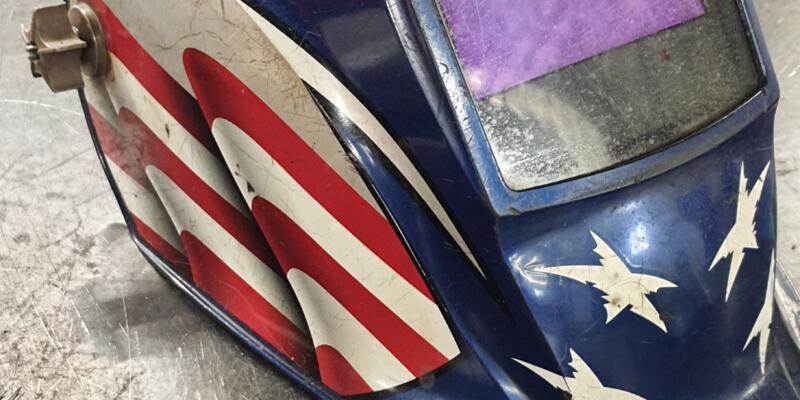
Another big ‘no-no’ is of course to look at a live welding process with the naked eye. Welders therefore will wear various forms of eye shielding. (See the featured image.)
Get in touch
We hope this Beginners Guide to Welding was of some use. If you have any pipework projects that require any of the above types of welds, get in touch via our enquiry form or call us on 01782 749421.